Using Tarot Cards & Casting Bones to Create Deeper Roleplaying Characters
Coins for the seven ancient planets, a three-card tarot spread, and colored dice matched to each influence. The esoteric character creation session that built the Convergence party.
Cleaned up Transcript
This is the weirdest video I’ve made, and one of the most valuable exercises in my whole hobby. Before I roll up the Convergence party on proper Dolmenwood character sheets, I take each of them through my own esoteric prep: a bag of bones, a tarot deck, and dice sorted by planetary color. The method is built on the character creation ideas in the Book of Antithesis, with a little bit of my own razzle-dazzle on top.
The goal isn’t to build a character. It’s to clear your mind, get your subconscious working, and let the muse (or Carl Jung himself, speaking from the grave) hand you someone who already feels alive.
The Method
Three tools, used in order:
- The bag of bones. A little sack of collected objects that each mean something to me. The important ones are seven coins (grymkin coins from Warmachine) that correspond to the seven ancient planets — Jupiter, Mars, Mercury, the Moon, Saturn, the Sun, and Venus. Shake the bag, cast the coins, and whichever land face up are the influences on this character. Each planet carries a color, an element, and a list of influences — wealth, luck, memory loss, protection. Think of it as astrology for your characters. The influences aren’t necessarily personality traits; they can be deities, factions, or forces working on the character from outside.
- Colored dice. Every planet has a color, and I keep matching dice for each. Whichever planet claims the character decides which 3d6 roll their stats, straight down the line. Fate gives what fate gives.
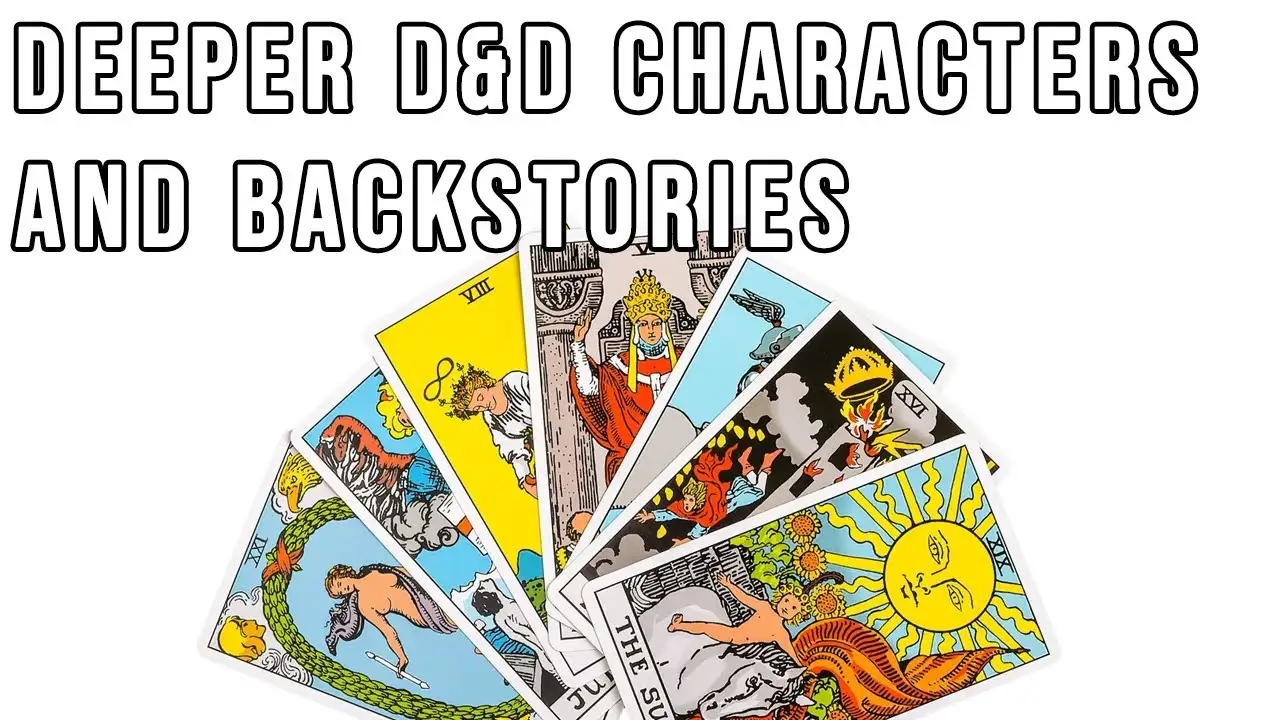
- A three-card tarot spread. I use the Rider–Waite–Smith deck. First card is the past — what they’ve recently overcome. Second card crosses them — their current challenge (always read upright, since it lies sideways). Third card is what the future holds. Pick a significator on vibes if one fits.
The whole point is to embrace whatever comes up. The synchronicities start immediately, and they’re what make it work.
Garreth and Barrow
Garreth Vale is the real test of the process — the other characters had backstories written and ready, but all I had for Garreth was a model I’ve loved for years and a note about how he meets the party.
I cast the coins and every single one lands face down. No influence at all. I’ve made a lot of characters this way and never seen it happen. He’s a true independent, outside it all — so he gets the clear dice. I only own one clear d6, so it’s three rolls per stat: 13 strength (respectable for a grizzled vet), 6 wisdom, 11 dexterity, 9 constitution, 13 charisma — and an intelligence so bad I broke my own rule and rerolled it up to 8, blaming the sharp-edged die that wouldn’t bounce. Otherwise he wasn’t even going to be able to talk to the party.
His spread: the Knight of Cups behind him — arrival, a proposition, an invitation. Which is exactly the backstory already written: Triste enticing him into a mercenary job escorting a mage into the forest. The Nine of Swords crosses him — failure, delay, deception, despair. Something to keep in my pocket as I DM for him. And before him, the Fool — a choice of vital importance, the supreme adventure about to begin. With that intelligence score, he is certainly a fool. An old vet about to walk into the adventure of his life.
Barrow the hound gets his own quick read: Five of Wands (the battle of life, now behind him), Two of Pentacles (new adventure, and he’s down for it), Ten of Cups (true friendship and happiness to come). He’s just a happy boy who gets to poop in a new forest.
Rollo
Rollo is a Monkstone Miniatures figure whose given name I loved too much to change. When I shake the coins, one literally jumps out of my hand — the wanderer coin, who happens to be a deity in my homebrew world. No need to throw the rest. The Wanderer corresponds to Mercury: water, luck, gratitude, memory, divination, poverty, memory loss.
Mercury’s color is yellow, so the yellow 3d6 roll his stats — and the first roll comes up 6-6-6. Eighteen strength. A little guy ready to smash. That’s what happens when you start messing with this kind of thing. The rest fall into place with eerie sense: low wisdom (he spent his whole life underground before being called to the surface as a warrior of the sun), 9 dexterity (he’s carrying that big shield), modest constitution, and 16 charisma — a little cutie with a heart of gold.
His significator is the Knight of Swords, rushing headlong into destiny. The spread: Seven of Cups reversed — determination, a project about to be realized — right as he’s just clawed his way to the surface. Six of Swords crossing him: passage away from difficulty. And the Two of Swords reversed ahead: caution against dealing with rogues. He’d better keep an eye on somebody in this party.
Thorek Duskworn
Thorek is the one party member with real table history — I played him in a campaign that fell apart before he got his destiny. His first cast comes up with five planetary influences pulling at him. Five influences, three dice — so I cast again to see who really holds him, and get exactly three face up: the Moon, Mars, and Venus as major influences, Mercury and Saturn watching from the minor.
I don’t reroll his stats. The numbers we rolled in the Dolmenwood video were so perfect for him that he was clearly forcing his way into this campaign, so those stand. His significator is the Hierophant — if you know his story, the failed priest who denounced the gods, you know why. His spread: Seven of Swords reversed, the Wheel of Fortune crossing him, and the Ten of Wands reversed ahead.
Triste
The camera died partway through Triste’s session, but the dice were recorded in the notes: 9 strength, 7 intellect, 9 wisdom, 6 dexterity, 6 constitution, 4 charisma. Yikes. She’s a young elf — maybe that’s exactly what those numbers are telling us.
No significator felt right, so she stands for herself. Her spread is heavy with royalty: the King of Wands behind her — honesty, nobility, an unexpected heritage — the life of elven leisure and wealth she left behind to go experience the human world. The Five of Cups crossing her: vain regret, loss, an inheritance not up to expectations, the rejection of pleasure. And the Queen of Wands reversed ahead: opposition, jealousy, deceit.
Eloryn
The mage. The only thing we know about Eloryn is that he’s hunting an artifact in the middle of this forest. His first cast: everything face down — but where Garreth’s empty cast read as independence, Eloryn’s reads differently. He has five minor influences circling him, and when I cast again to narrow it down, all of them land face down again. Nobody will give up their stake in him. Everybody wants a piece of the mage.
So that’s how we play it: 5d6, keep the best three, with each die a different planet fighting for him. Watching the rolls, a pattern forms — the Sun and Venus run consistently high, pushing him forward, while Mercury and Jupiter run low, doing their best to hold him back. He comes out a monster: strong for a mage, dextrous, the tankiest constitution in the party, and 17 charisma. He presents very peaceful, very do-goody. I might suspect ulterior motives. I might.
His spread: the Hermit behind him — of course it is — silent counsel, a meeting with one who will guide the seeker toward material or spiritual goals. The Six of Pentacles crossing him: philanthropy, charity, prosperity shared with others — not what I expected for him, and worth sitting with. And the Queen of Cups reversed ahead: a good woman in some ways, but perverse; dishonesty or immorality. The dishonesty is exactly what I’ve had in mind.
Those planetary dice aren’t done, either. When a big roll comes up in the campaign and Jupiter and Mercury are trying to stop Eloryn from doing what he’s doing, those dice go in the box with the rest. It keeps the deities in the game.
The Party Converges
So here’s where the readings leave us: Eloryn hires an escort through the woods to recover an artifact to “further his studies.” Triste talks her longtime companion Garreth into the mercenary job — he’s out of the army, late thirties, aimless, and doesn’t know what to do with himself. On the road through the forest they come upon Thorek, who has just healed Rollo after finding him torn up on the forest floor by something the little knight wasn’t prepared to face.
The party is together. Their adventure begins soon.
This one fills my bucket back up in a way even painting doesn’t. Painting pours something out of me; this pours something back in. I just created five people. The bag of bones will absolutely return in the solo play as an oracle, and the cards are always here with me. Thorek already has his Dolmenwood sheet — next up: sheets for the rest of the party.