Rolling Up Thorek Duskworn, the Apostate Cleric of Convergence
Thorek Duskworn gets his Dolmenwood character sheet. A dwarf cleric who denounced his gods, walking into a world where dwarves do not exist and where the class rules fit his story almost too well.
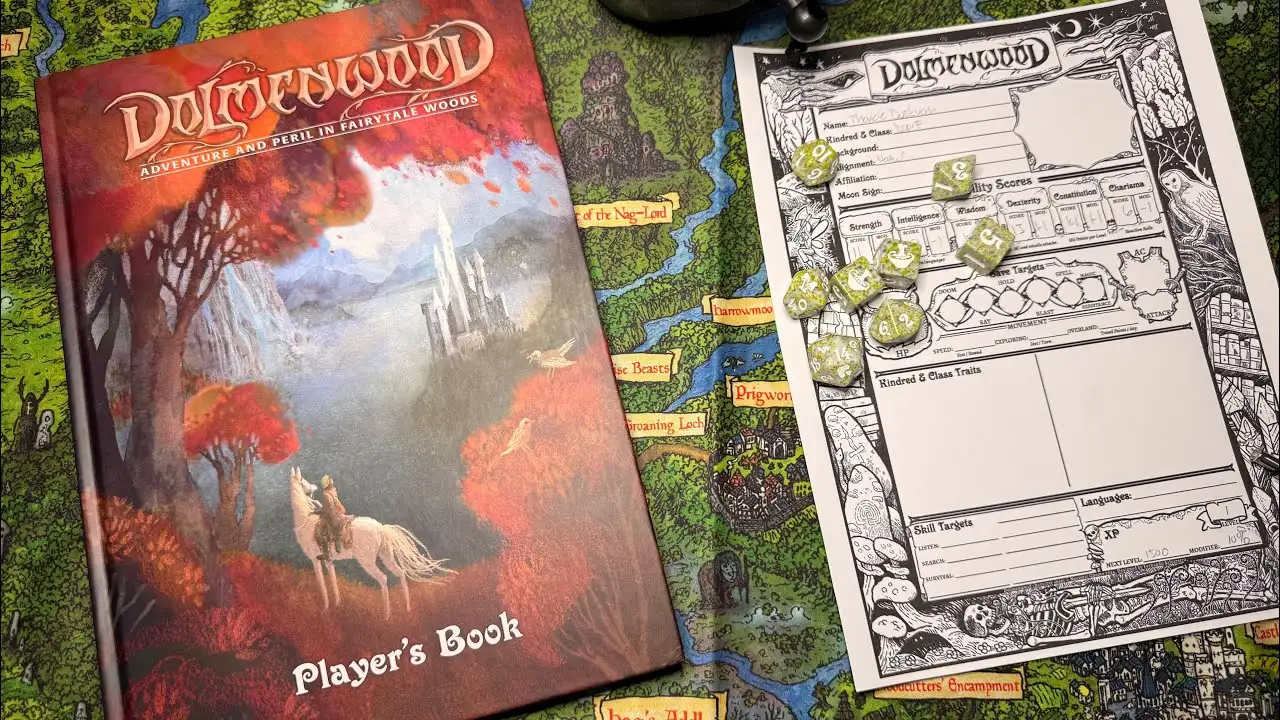
Last time I cast the bones and read the tarot for the whole Convergence party. Tonight, the first of them gets a real Dolmenwood character sheet: Thorek Duskworn, dwarf cleric, apostate.
The video is also a full flip-through of the Dolmenwood Players Book — kindreds, classes, magic, the works. If you want the page-by-page tour of the book itself, that write-up lives over on Hobbinomicon. This post is about Thorek.
The Problem With Thorek
Dwarves are not in Dolmenwood.
The Players Book gives you breggles, mosslings, grimalkin, elves, woodgrues, and humans — no dwarves anywhere. Thorek comes from Old School Essentials, because he’s a figure and a character I’ve loved for years and he was forcing his way into this campaign whether the kindred list allowed it or not. Everything else about him is built by the Dolmenwood book; only his kindred is imported. And honestly, the mismatch is the hook. People of the wood have never seen anything like him, and I can’t wait to roll those reactions.
If you know his story, you know why cleric is a loaded choice. Thorek was a priest whose god went silent when it mattered most. He denounced the heavens, tied a dead child’s doll around his neck, and walked away from his faith. He’s not a holy man anymore. He’s a man trying to find out where the power actually comes from.
The Stats
These were rolled 3d6 down the line back in the unboxing video — because we’re not cowards — and they were so perfectly Thorek that I refused to touch them when we did the bones and tarot session:
- Strength 11 (+0) — sturdy enough
- Intelligence 7 (−1) — a little dopey
- Wisdom 17 (+2) — there it is
- Dexterity 13 (+1)
- Constitution 14 (+1)
- Charisma 6 (−1) — the wood will not find him charming
Dolmenwood has a rule I didn’t know about: you can lower a non-prime ability by two points to raise a prime ability by one. I stared at that 7 intelligence and thought about shaving dexterity to fix it. Then I put the pencil down. I’m resisting the urge to min-max. A 17 wisdom sitting next to a 7 intelligence is a character — a man with deep spiritual insight who is not, strictly speaking, clever. That’s Thorek.
The Cleric Chassis
Wisdom is the cleric’s prime ability, and with a 17 Thorek earns a +10% experience modifier. He needs 1,500 XP for level two.
Hit points are 1d6 plus constitution modifier. I rolled a five, plus one: six HP, the maximum possible. Given how the rest of the party’s stats came out, our failed priest might genuinely be the tank.
Clerics can wear any armor including shields (nothing arcane or fairy) and use any weapon except arcane ones — which is a quiet gift, because the figure is modeled with sword and shield, a combination clerics often can’t legally carry in old-school games. So the sheet matches the miniature: chain mail, shield, long sword, and a holy symbol. His holy symbol is the doll. It was always going to be the doll.
An Apostate at the Gates
Here’s where the Dolmenwood rules lined up with Thorek’s story so cleanly it felt arranged:
- Alignment. Clerics must be lawful or neutral. Thorek enters neutral — he’s turned his back on the gods of his homeland and owes nothing yet to anyone else’s.
- No spells at level one. Holy magic only comes once a cleric has proven their devotion, at level two. Thorek walks into Dolmenwood with a silent heaven and empty hands, exactly as his story demands.
- Holy order at level two. You don’t pick an order until you level. So the wood itself gets to decide what Thorek finds faith in — the Pluritine Church, something older, something stranger. I get to discover it in play.
It’s almost like it was meant for us to have a dwarf from outside Dolmenwood, so he can arrive before any of these decisions have to be made. Something in that first adventure is going to reach for him, and I don’t know what it is yet.
When the spells do come, they’ll land harder for how Dolmenwood writes them: every holy spell has an associated saint and a prayer name. He won’t cast detect evil; he’ll speak a benediction. For a man who stopped praying, the first prayer name out of his mouth is going to matter. As for clerical tenets, I suspect he lands on sanctity of life — the rest of it he just doesn’t vibe with, and a man carrying a child’s doll around his neck has already told you what he couldn’t forgive.
The Planets Stay in Play
One carryover from the esoteric session: Thorek’s planetary influences — the Moon, Mars, and Venus major, with Mercury and Saturn watching — go on his sheet. For ordinary rolls he’ll use the Dolmenwood dice, but when a moment feels like the powers are leaning in, the matching planetary dice come back to the table. It keeps the deities in the game for a character whose whole arc is about which of them, if any, deserves him.
One down. Rollo, Triste, Garreth, and Eloryn still need their sheets — and then the party walks into the wood.